
As temperatures drop across Spartanburg, Greenville, and Anderson, drivers should be watching for more than just the usual traffic. Fall marks the start of deer breeding season in South Carolina, and with it comes a sharp, predictable rise in deer-vehicle collisions on Upstate roads.
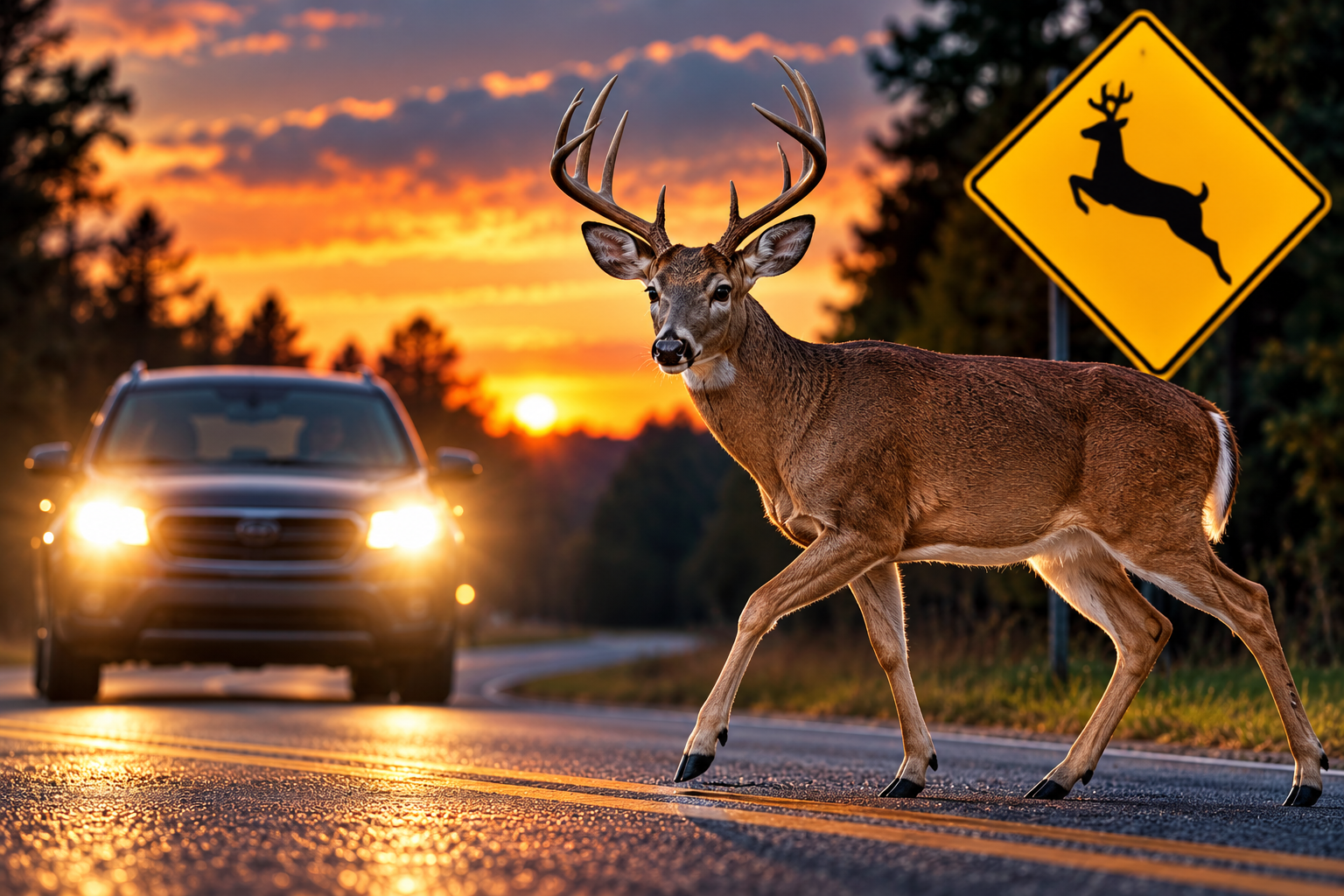
According to the South Carolina Highway Patrol, the state sees roughly 6,000 reported deer-vehicle collisions every year, and nearly half happen in October and November alone. Greenville and Spartanburg counties are consistently among the areas hit hardest, largely because dense population growth along corridors like I-85, I-26, and the connecting state highways has pushed neighborhoods right up against the wooded and agricultural land deer call home.

South Carolina Department of Natural Resources has pointed to two forces driving the seasonal spike. First, deer become far more active and less predictable during the fall rut, or breeding season, often moving at dawn and dusk when visibility is already limited. Second, as suburban development continues to expand across the Upstate, hunting pressure in many areas has decreased, allowing local deer populations to grow larger than they might have a generation ago.
It’s worth remembering that a deer-crossing sign doesn’t mean deer are actively crossing at that moment — it marks a stretch of road with a history of past strikes, not a live warning system. That’s part of why these collisions catch so many careful drivers off guard.
A few habits can meaningfully reduce your risk during deer season. Slow down when driving near the edges of wooded lots, pastures, or agricultural fields, especially in the early morning and around sunset. Use your high beams when there’s no oncoming traffic, since they’ll catch a deer’s eyes and give you more warning. If you see one deer cross the road, assume others are close behind — they tend to travel in small groups. And if a collision becomes unavoidable, SC DNR’s guidance is consistent: it’s generally safer to brake firmly and hit the deer than to swerve, since swerving is what causes many of the more serious crashes — running off the road, overcorrecting into another lane, or colliding head-on with oncoming traffic.
What you do immediately afterward matters, too. Move to a safe location if your vehicle is drivable, turn on your hazard lights, and call 911 if anyone is injured or if the vehicle is blocking the roadway. Take photos of the scene, your vehicle, and the road conditions before anything is moved, if it’s safe to do so.
From a legal and insurance standpoint, not all deer-related accidents are treated the same way. A single-vehicle strike where you hit a deer head-on is typically handled under your comprehensive coverage rather than collision coverage, and it usually isn’t treated as an “at-fault” accident in the traditional sense. But when a driver swerves to avoid a deer and instead strikes another vehicle, a guardrail, or a tree, the situation becomes more complicated. Questions about who was following too closely, driving too fast for conditions, or reacting unreasonably can turn a simple deer strike into a disputed liability claim.
If you’ve been injured in a deer-related crash — whether you were the one who swerved or the other driver involved — it’s worth having someone review the details before you accept an insurance company’s first explanation of what happened and who’s responsible.
Frequently Asked Questions
Is hitting a deer considered an at-fault accident in South Carolina?
Generally, no. A single-vehicle collision where you strike a deer is usually covered under comprehensive insurance, not collision coverage, and isn’t treated as a fault-based accident. That changes, however, if swerving to avoid the deer causes a crash with another vehicle or fixed object — those situations are evaluated more like a typical car accident claim.
What should I do immediately after hitting a deer?
Get to a safe spot if your car can still move, turn on your hazard lights, and call 911 if anyone is hurt or the road is blocked. Document the scene with photos, and avoid approaching an injured deer, which can be unpredictable.
Can I still be held liable if I swerve to avoid a deer and hit another car?
Potentially, yes. South Carolina applies comparative negligence principles to these situations, meaning fault can be shared between drivers depending on speed, following distance, and reaction. An attorney can help sort out how liability should actually be allocated based on the specific facts.
Which areas see the most deer-related accidents in the Upstate?
Greenville and Spartanburg counties consistently rank among the highest in the state for deer-vehicle collisions, particularly along wooded corridors near I-85 and I-26, with the risk peaking in October and November.